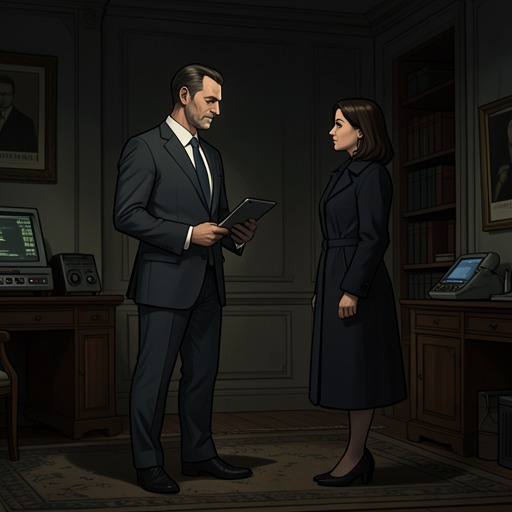
Ernst von Suchtlen’s heart
The RookErnst von Suchtlen’s heart is both a regenerative biological sample and the means by which von Suchtlen escapes surveillance. Sent through a mail-forwarding service to Myfanwy, it grows into a heart and then, over months, into a living man inside a Checquy laboratory freezer. The device carries an identity across bodily destruction, but its slow, imperfect operation brings von Suchtlen back into a world whose political circumstances have changed without him.
Origin and Delivery
The heart first reaches the Checquy as a parcel addressed to Myfanwy’s predecessor. Myfanwy herself has only read about its receipt, but when a Belgian man arrives to speak with her, he identifies the mailed organ as his own. He explains that he grew himself from it in the scientists’ laboratory freezer. The apparent arrival of an unexplained body thus turns out to be the return of a person who had used the Checquy’s possession of his heart as part of an escape plan.
The parcel’s route concealed its source. With his laboratories’ entrances and exits watched, his telephone lines tapped, and his cousin’s growing paranoia restricting his movements, von Suchtlen says he was nearly a prisoner. He had also arranged for his cousin’s assistant to be interrogated, making it too dangerous to rely on his own assistant to place calls. He therefore left the box in a mail-out tray; it passed to a mail-forwarding service and then a courier, who delivered it to the Checquy. The heart was not simply a biological curiosity sent to an unsuspecting recipient: it was the only route von Suchtlen believed would get him out of the guarded facilities undetected.
Regeneration and Its Costs
The process begins with a sample taken from the original body. Von Suchtlen says that the new body retains the memories he possessed when the sample was taken, while the sampling itself strips vital components from the original. That body begins breaking down about an hour later, leaving just enough time to pack the sample and enter a shower; the remains then liquefy. The method therefore avoids two simultaneous versions of the same man: the old body does not continue alongside the new one.
The sample grows into a heart before delivery, pauses, and then regenerates into an entire person. Von Suchtlen describes the expected interval as a couple of weeks and says that even dissection cannot prevent the heart from growing again. The capability is powerful but not equivalent to the more extensive abilities Grafters can provide through surgery: a person regenerated this way can choose only a couple of abilities, and the procedure carries risks. Early subjects could suddenly melt into a slurry. Von Suchtlen says that the defect had mostly been corrected, though he accepted the remaining danger.
Escape and Merger Plan
Von Suchtlen intended the heart’s slow regeneration to give him a way to move beyond his cousin’s surveillance and to resume negotiations from outside the guarded laboratories. He believed his cousin had been told that he would remain secluded in his quarters for contemplation and strategic planning. If the cousin came to investigate, he would find no body. Von Suchtlen accordingly expected to emerge free to negotiate a merger between the Wetenschappelijk Broederschap van Natuurkundigen and His Majesty’s Hidden Soldiers of the Checquy.
The plan depended on a false picture of events: von Suchtlen assumed his cousin would still be available to receive the result as a fait accompli. He reasoned that, if Gerd could not accept the merger, the combined forces of the two organizations could subdue him and whatever forces he could muster. The heart let von Suchtlen bypass the immediate surveillance problem, but it could not preserve the political situation in which he had devised his strategy.
Delay and Consequences
When Myfanwy explains what has happened, she first corrects the regeneration timetable. The process has taken months, not the weeks von Suchtlen expected, meaning the experimental technology has not worked as intended. She then updates him on his cousin’s recent actions and tells him that Gerd is dead, killed in the assault. His anticipated negotiation and possible confrontation have both been overtaken by events before he could emerge.
Von Suchtlen repeats the news of Gerd’s death and slumps back, visibly shocked. The news changes the meaning of his return: the heart has successfully carried his memories into a new body, but it has not delivered him back to the moment from which he left. During the conversation, his initially hairless scalp develops stubble, a visible sign that his new body is continuing to change even as the plan it was meant to enable collapses. The object’s central irony lies in that mismatch: regeneration preserves a person’s remembered past, while the months required to achieve it allow the external world—and the relationships on which his plans depend—to move on.